-

“Two dreams and a cup of coffee later…..”
F.K. PrestonKopi Time
-
the agent from the black lagoon……

Gargoyle on Books
by Walter S. Arnold, Sculptor / Stone Carver, Chicago IL 2002
I did a rat-a-tat-tat on my knee. Crossed my legs the other way. Did a rat-a-tat-tat on the other knee. Didn’t help. Wiggled my foot, making circles with it. Helped a little. It was a five-minute drive, and it felt like five seconds. I popped out of the car, lugging my bag behind me, and slammed the door, ready for whatever fate had to hand me.
The UW-Milwaukee Spring Writer’s Festival. My first time, and I had no idea what to expect. As I faced the elevator doors, I thought about pushing the button to the 13th floor, and getting off in another place, infinitely less scary. But I pushed seven, and the doors opened to a huge, carpeted expanse. At the far side was a table. A table that stretched on and on and on, covered with folders neatly lined up, name cards attached to each. Folder after folder after folder, and mine was the first to be pulled, leaving a blank space in the neat line up. First to arrive; was it a faux pas?
I fanned my face a little and looked inside the folder for the map of the building. I had signed up for a special query letter workshop, with a real agent. Room 770. The hair on the back of my neck prickled, and I froze outside the door. Three participants walked in while I did my deep breathing – one inhale exhale. Two inhale exhale. Three inhale exhale. I pulled my shoulders back, grasped the door handle, and pulled.
It was a large, bright room with tables placed in a square, and at the front table was seated a woman. She glanced up. It couldn’t be her. I was looking for the curved teeth, fire breathing, hackles raised, wings unfurled, pointed tail, gargoyle. Not this pleasant woman.
Her voice was soft. She paused for a second before she spoke. Thoughtful, not strident. She greeted me, and the rest of the writers as they trickled in. And then she began the workshop.
Sheree Bykofsky, founder of Sheree Bykofsky Associates, Inc., Literary Agency, originally located in New York, and now in beautiful Brigantine, New Jersey.

Sheree generously and graciously shared with us the six secrets of published authors:
1. Persistence and perseverance – you really must have a tough skin.
2. Keen sense of the market place – your book has to have a shelf in the bookstore.
3. Professional attitude toward your writing – I am a writer and it is my job.
4. Ability to meet deadlines.
5. Understand the book publishing business.
6. Be willing to promote your own book – in the modern market place publishers don’t have a lot of money for publicity.And then she went into detail, and had us practice, writing a query letter and a three sentence pitch. We critiqued each other, harvested ideas, learned a lot from Sheree and each other, and had fun.
On her website, Sheree wrote a letter to all authors querying her:
Dear Author,
I am Sheree Bykofsky, founder and President of Sheree Bykofsky Associates, Inc. Thank you for your interest in my Web site and my agency. Please call me Sheree.I am a generalist and have eclectic and sometimes eccentric tastes. I represent all areas of non-fiction and commercial and literary fiction. I don’t limit myself to particular genres because I’m always surprised by what appeals to me. If I love it, then I’ll take it on. The only way to know is to try me. If it needs work and I want to represent it, I’ll tell you. If I choose not to agent you, you should know that I’m not judging you or your writing, or even your idea. I am saying that it’s just not right for me. Please also keep in mind that it is my strict policy not to give feedback when I pass on a book. What isn’t right for me may be perfect for another agent.
Yes, she really was that nice. I will not be afraid to send her a query about my project, even though it is not strictly on her list of favorite things. Who knows – it is worth a try. And my skin won’t have to be too thick to receive a rejection from her.
The rest of the conference – Friday evening opening speaker and Milwaukee native Lori Tharp, through Sunday noon and closing reading by novelist Keith Donohue, was wonderful as well.
I recommend the Spring Writers Festival to anyone interested in writing, and I guarantee there is nothing to be afraid of!

-
the irish pirate queen, Gráinne Ní Mháille

I am known here by my alter ego, at least in name: Qugrainne. This is a shortened, yahoo style handle, which comes from the name Gráinne Ní Mháille. Gráinne is also know as the pirate queen of Connaught – and her Anglicized name of Grace O’Malley.
Gráinne was born in 1530 in Ireland, of course. If you remember history, you will know that Henry VIII was the king of England at that time. Gráinne was of noble birth too: her father was chieftain of the O Mháille clan, and controlled much of what is now called County Mayo. Gráinne was the only child of her parents, who came from a long line of seafarers.
The story is, Gráinne wanted to go sailing too, just like her father. She was what we would in my childhood have called a tomboy. When she begged to go on a trip to Spain with her father, he told her she couldn’t go because her hair was too long and would have put her in danger of getting caught in the ships ropes. Easy solution to that problem, right? Of course she cut off her hair, and her father had no further excuse to deny her sailor’s rights.
She married at 16 to Dónal an-Chogaidh (Donal of the Battle) O’Flaherty and they had three children: Owen, who was murdered by the English when he was in his late 20’s, Margaret, who was much like her mother, and Murrough who was an absolute sexist and joined forces with his older brothers’ murderers. Gráinne never spoke with him again after this traitorous act.
Husband Donal was killed in battle, and in 1566 Gráinne married Richard-an-Iarainn Bourke, with whom she had one son. After a year of marriage, Gráinne yelled from their castle window, “Richard Bourke, I dismiss you,” and the divorce was final. She kept the castle.
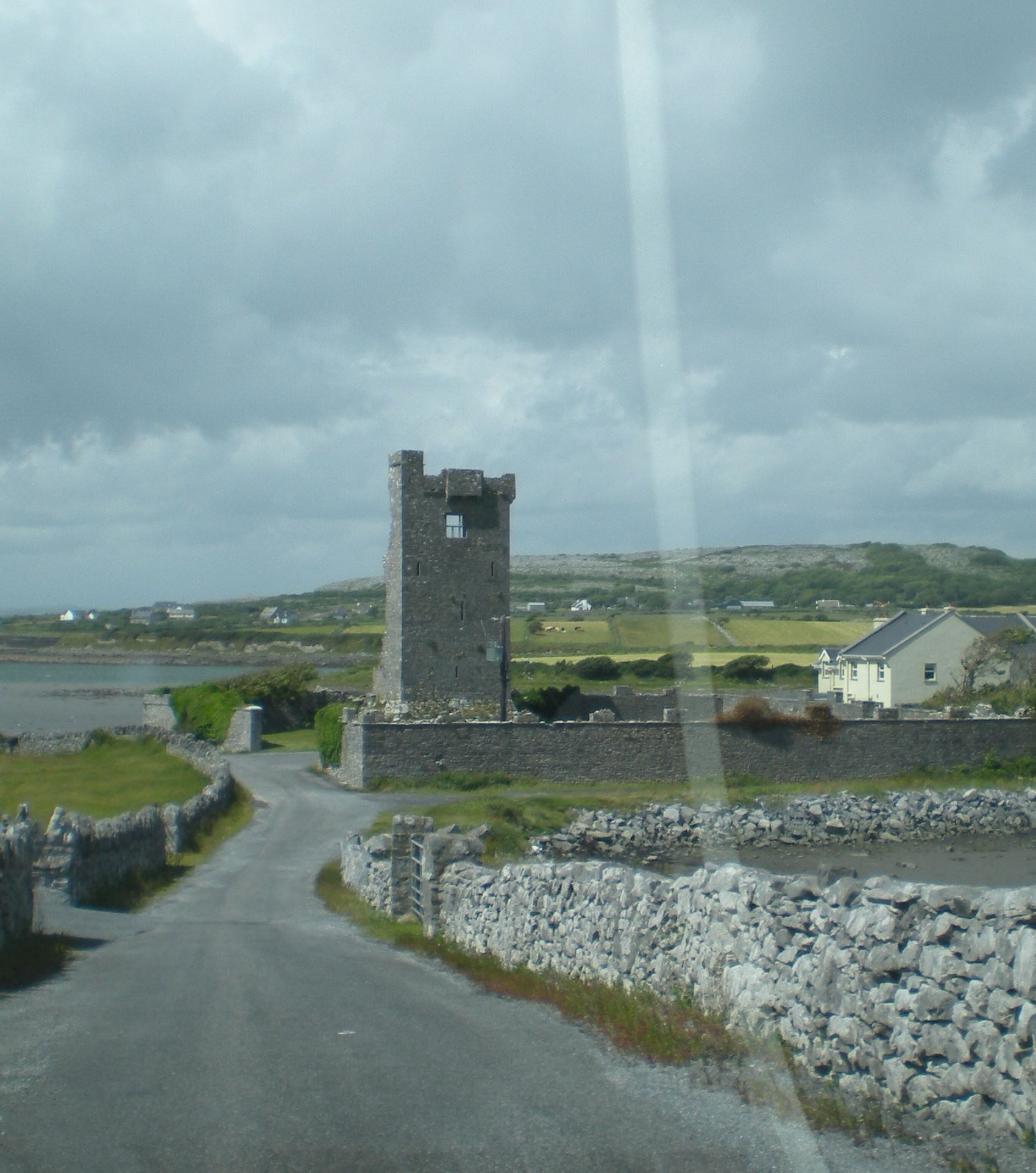
Gráinne did follow in her family’s footsteps and amassed a fleet of her own. As the British charged tax for ships entering their waters, thus did Gráinne board ships to collect tax when they entered her waters. The English called this piracy. Eventually she got a little more aggressive, and became a pirate queen in earnest, attacking ships and fortresses held by other Irish clans as well as the English. She also became very wealthy.
In 1593 the English governor of Connaught, Sir Richard Bingham, captured two of Gráinne’s sons and her brother-in-law. Gráinne sailed to England to petition Queen Elizabeth for their release. It is the general consensus that Gráinne must have spoken Latin, because the Queen of England did not speak Gaelige, and Gráinne did not speak English. Gráinne also requested that Richard Bingham be removed from office, and in return she would stop supporting Irish rebellion. Elizabeth did not live up to her word so neither did Gráinne. She continued her pirating ways until her death in 1603, the same year that Queen Elizabeth died.
There are stories and songs written about the exploits of Gráinne Ní Mháille. She finds her way into movies, Broadway plays, and famous literature. My favorite take on the pirate queen was performed by Maggie Cronin in Milwaukee in 1999, at Cecilia’s Pub. Damien Jaques, the Journal Sentinel theater critic wrote a review of the one-woman play:
The best example of compelling stagecraft in Milwaukee is being presented on one of the city’s most unconventional stages. Irish actress Maggie Cronin is making her North American debut with her one-woman show “A Most Notorious Woman” on a small stage tucked into a corner of Cecilia’s Pub in Walker’s Point. In 85 engaging minutes, Cronin demonstrates that thrilling theater can happen anywhere. She plays all of the characters herself.
“A Most Notorious Woman” is about Grace O’Malley, a 16th century sea captain and pirate who harassed the English during their drive to conquer Ireland. In probably her most audacious act, Grace sailed her pirate ship up the Thames River to confront Queen Elizabeth I over the English’s kidnapping of her son. O’Malley was a “hard woman, a handsome woman, a wife twice and a mother,” to quote the play. Rumor had it that at least one of O’Malley’s children was born at sea.
After doing extensive historical research, Cronin, who lives in Belfast, wrote “A Most Notorious Woman” several years ago. Filled with sly and clever humor, the piece jumps back and forth in time and mixes historical periods with amazing ease and clarity. For example, Elizabeth I talks on a cell phone at one point in the play, but putting a late 20th-century gadget into the hand of a late 16th-century queen does not confuse or appear ridiculous.
Credit that to the perfect melding of text with actor. Cronin is clearly a writer. Her play is intelligent, inventive, playful and blessed with the Irish gift for vividly descriptive language.
She connects O’Malley’s unlikely life at sea with the 19th and 20th –century women who emigrated from Ireland by boat. That concept may seem on paper to be a bit of a reach, but in performance it makes absolute sense. Perhaps that is due to the spell Cronin the actress casts. She holds the room from the moment she first opens her mouth, creating magical moments with seemingly no effort. In the blink of an eye, Cronin folds a sheet of cloth into a wrapped newborn infant whose breath you can almost see. In another blink, her soft, pretty face twists into the contorted grimace of a salty old male pirate.
There is a raw and exciting theatricality at work here that cannot be bought with big budgets and fancy surroundings. “A Most Notorious Woman” also proves to be an entertaining history lesson. Cronin gives us a glimpse of a fractious tribal Ireland that fought itself as much as it fought the British.
What a treat it is to have Maggie Cronin in Milwaukee.

A grand time was had by all, the show was extended an extra week, all seats were sold. I regret to have lost touch with Maggie, and I have found there are no you-tube videos of her play. It is a loss for all of us because she was fantastic.
So that is the story of Queen Gráinne – Grace O’Malley. She was long my hero, and then I even got to meet her!
(All photos of Ireland, including blog header, were taken by my son.)
-
of all things irish…… st. cecilia?

Saint Cecilia from A Book of Saints, Anness Publishing Ltd.
And you thought I would have a picture of Saint Patrick to start off my series on Saint Patrick’s Day and all things Irish! He will show up here sooner or later, but I first wanted to write about another saint who is very important to me: Saint Cecilia. Cecilia is the patron saint of music, martyred in the 3rd century. This is her story from the Domenico Zipoli Institute:
The story of St. Cecilia is by itself a romance. Cecilia was a maiden of noble birth, and at an early age, she dedicated her life to God with a vow of chastity. She, however, was betrothed and married to a young noble named Valerian. On her wedding day, she prayed to the Lord and asked Him to protect her virginity. History records, “The day on which the wedding was to be held arrived and while musical instruments were playing she was singing in her heart to God alone saying: Make my heart and my body pure that I may not be confounded.” Her husband agreed to respect her vow. At this time, Christianity was still illegal in Rome, and after her husband was executed, Cecilia was also sentenced to death. It required two attempts, however. She was first locked in a bath in her own home to be suffocated by the steam. When she emerged from the bath unharmed, she was then beheaded. The stroke of the axe failed to sever her head from her body, however, and she lived for three days, and was said to sing throughout the ordeal.
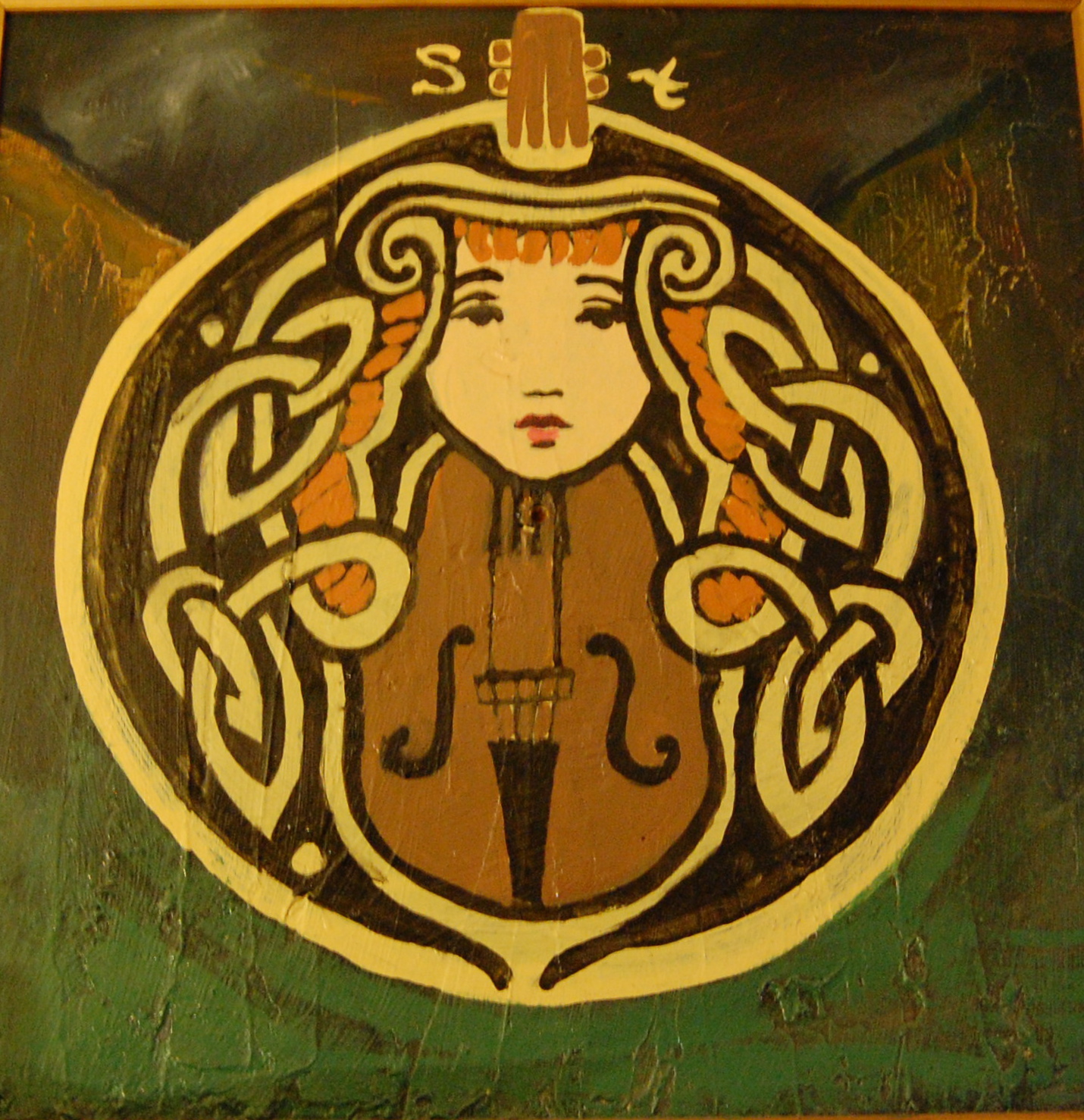
Obviously, Cecilia was a Roman, not Irish. Being the patron saint of music is what brought her to me, and I named my pub after her. It was a grand pub, with music, poetry, theater, story telling, sessions, salon night, good food, and just a wee bit of drink. I wrote a newsletter that included a calendar of events every month, that went out to a large mailing list. Great memories of a fun time. Milwaukee has a fairly large Irish community, as well as the largest Irish Musical Festival in the world at the Summerfest grounds every summer. There was a lot of support and wonderful patronage during the life of Cecilia’s Pub.
Friend and poet James Liddy, who recently succumbed to cancer, wrote this poem for Cecilia:
Ode to Cecilia’s Pub
Bless this public house and those who thirst.
I enter a supplicant suitor tactican.
Bless new world pints.
When I was a neophyte
pubs had no couches or barwomen,
They had politics one of the true religions.
Women had lounges, where they drank
And thus voted. I voted the arts
And met them, their eyes and elbows.Parents said they spend 40% of income
In these places – I inherit liberation,
libation is liberation.I adore the look of vacant bar stools.
I pray to Saints Dionysius and Cecilia.
At midnight the cry is
the bridegroom comes.A bartender is the flower on the far side
of the counter, friends flowers on this side.
Enter into the heart… that is illumination.
Ordinary karma void filled
with sustainable soul and body.I’ve fallen for a polished wood counter,
green, walls, a vista to the jakes.
Another round of pints, Michael.How many pouring hours to close?
St. Love the bartender delivers the answer.
November 22. 1998There was Guinness Stout, Beamish Stout, Harp Lager, Newcastle Brown Ale, Fuller’s Extra Special Bitter, Tullamore Dew, Power, Jameson 1780…. and Potcheen. Now that was some nasty stuff. My eyes water thinking about it! One of many special events was an evening called Black Velvet Night. Special drinks were served up during that celebration, including Black Velvet (Guinness and champagne), Half and Half (that’s the one made with Harp), Black and Tan (the one made with Bass), Purple Meany (Guinness with a shot of cassis), and my favorite, Golden Cream. After the head on the Guinness totally settles, you add several scoops of vanilla ice-cream. Yum!

Slάinte
-
the power of the written word
The Write on Wednesday prompt,
How do you find positive things to write about in these troubled times? Do you think the written word has the power to effect positive change?

What came first, the robin or the egg? What came first, the use of language that produced the larger brain capacity, or the larger brain that facilitated the higher-level cognitive processes of language and communication? According to Alfred Burns in his book The Power of the Written Word: The Role of Literacy in the History of Western Civilization, “the two steps were taken concurrently and seem inextricably connected.” He also states,
…language was at the heart of the evolutionary step which created the species of homo sapiens. And apparently human evolution stopped with its creation. In the 30,000 years since Paleolithic man left his sophisticated paintings and ingenious tools in the caves of France and Spain, no further evolution is discernible.
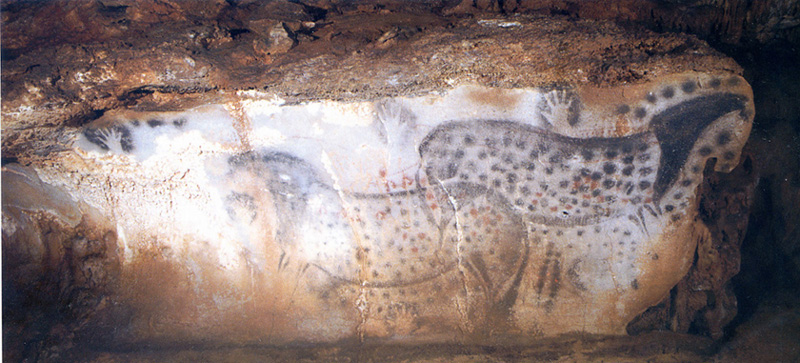
I find this fact rather odd. Was 30,000 years ago the apex of our evolution, and there is nowhere to go from here? Or, maybe we don’t need anything else, because our brains are capable of taking care of any further business? Back to that point 30,000 years ago, when humans first came up with the idea of communicating with pictographic signs on cave walls. An example is the lovely paintings in Pech-Merle Cave in Lot, France from 14,000 BC. In this particular painting, you see a spotted horse with a negative hand imprint next to it. Is this the artist’s signature, identifying him in particular, and later inspiring the development of written language, the next step in development of word-syllabic phonetic writing?
The next step in the history of our literacy was the creation of the alphabet, followed by the invention of the printing press and the introduction of paper. Can you imagine a world without books? The University of Cambridge owned a total of 180 books before Johann Gutenberg came along in 1454 and invented the first printing press with movable metal type.
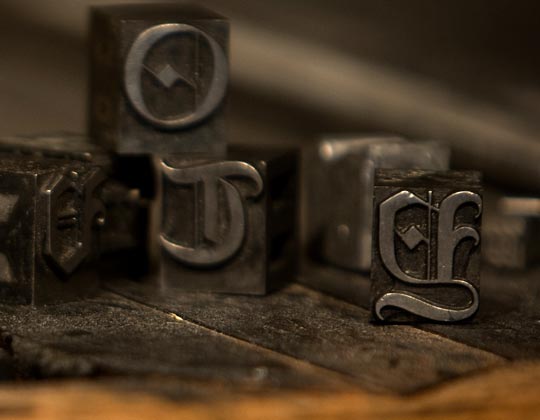
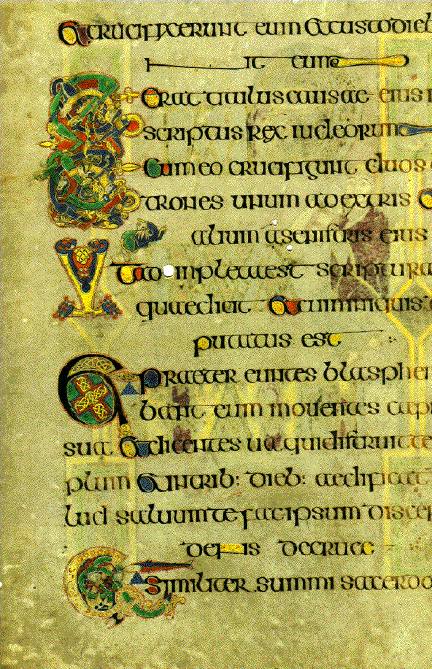
Before this, all books had been written by hand, one book at a time. These are beautiful, of course, but with the development of printing, a scribe’s work for one day could be accomplished in a few minutes.
Which brings us to the present, and the invention of the computer, the personal computer, blogs, email, and all the other wonderful conveniences of our time. My grandma, who died at 93 years old a few years ago, just could not wrap her brain around the concept of email. What unfathomable invention will be next for us?
Here I am after following this circuitous route, back to the original question posed by Becca: Do you think the written word has the power to effect positive change? From the brief history recounted above, the written word has obviously gone through a lot of change in tandem with us, be it positive change or not. Proscribing to the cup-half-full philosophy, I would say positive change is most certainly affected and effected by the written word. Writing makes knowledge and communication permanent (regrettably true after one has written a passionate communication with someone and then broken off the relationship…..). But this permanency of writing also makes available the unlimited sharing of ideas and the potential growth from building upon them. Why would there be so many “self help” books on the market if readers didn’t truly believe they might change their lives just by reading them?
What about writing a journal or a memoir to expel the emotions of the past, to bring order to a chaotic mind, or sooth a tormented soul? In The therapeutic Power of the Written Word in The London Independent, Terence Blacker points to his personal evidence:
[what about] the air of gentle sanity that hangs over a literary festival like the scent of roses, the pleasant and easygoing natures of contemporary writers, with their strong yet modest sense of self, their quiet wisdom about the world beyond the study.
I love the picture evoked for me from those words: I want to be there!
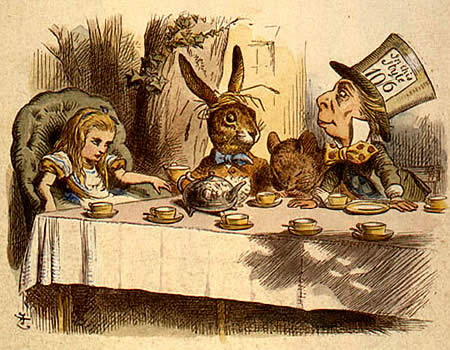
Oops. That is a tea party I wanted to attend, not a literary festival.
All of this reading and writing and ruminating led me to a poem, which made me smile:
Writing in the Afterlife
by Billy Collins
I imagined the atmosphere would be clear,
shot with pristine light,
not this sulphurous haze,
the air ionized as before a thunderstorm.Many have pictured a river here,
but no one mentioned all the boats,
their benches crowded with naked passengers,
each bent over a writing tablet.I knew I would not always be a child
with a model train and a model tunnel,
and I knew I would not live forever,
jumping all day through the hoop of myself.I had heard about the journey to the other side
and the clink of the final coin
in the leather purse of the man holding the oar,
but how could anyone have guessedthat as soon as we arrived
we would be asked to describe this place
and to include as much detail as possible—
not just the water, he insists,rather the oily, fathomless, rat-happy water,
not simply the shackles, but the rusty,
iron, ankle-shredding shackles—
and that our next assignment would beto jot down, off the tops of our heads,
our thoughts and feelings about being dead,
not really an assignment,
the man rotating the oar keeps telling us—think of it more as an exercise, he groans,
think of writing as a process,
a never-ending, infernal process,
and now the boats have become jammed together,bow against stern, stern locked to bow,
and not a thing is moving, only our diligent pens.For me, heaven. For someone else, maybe hell!
I cannot end this post without an update on the baby:
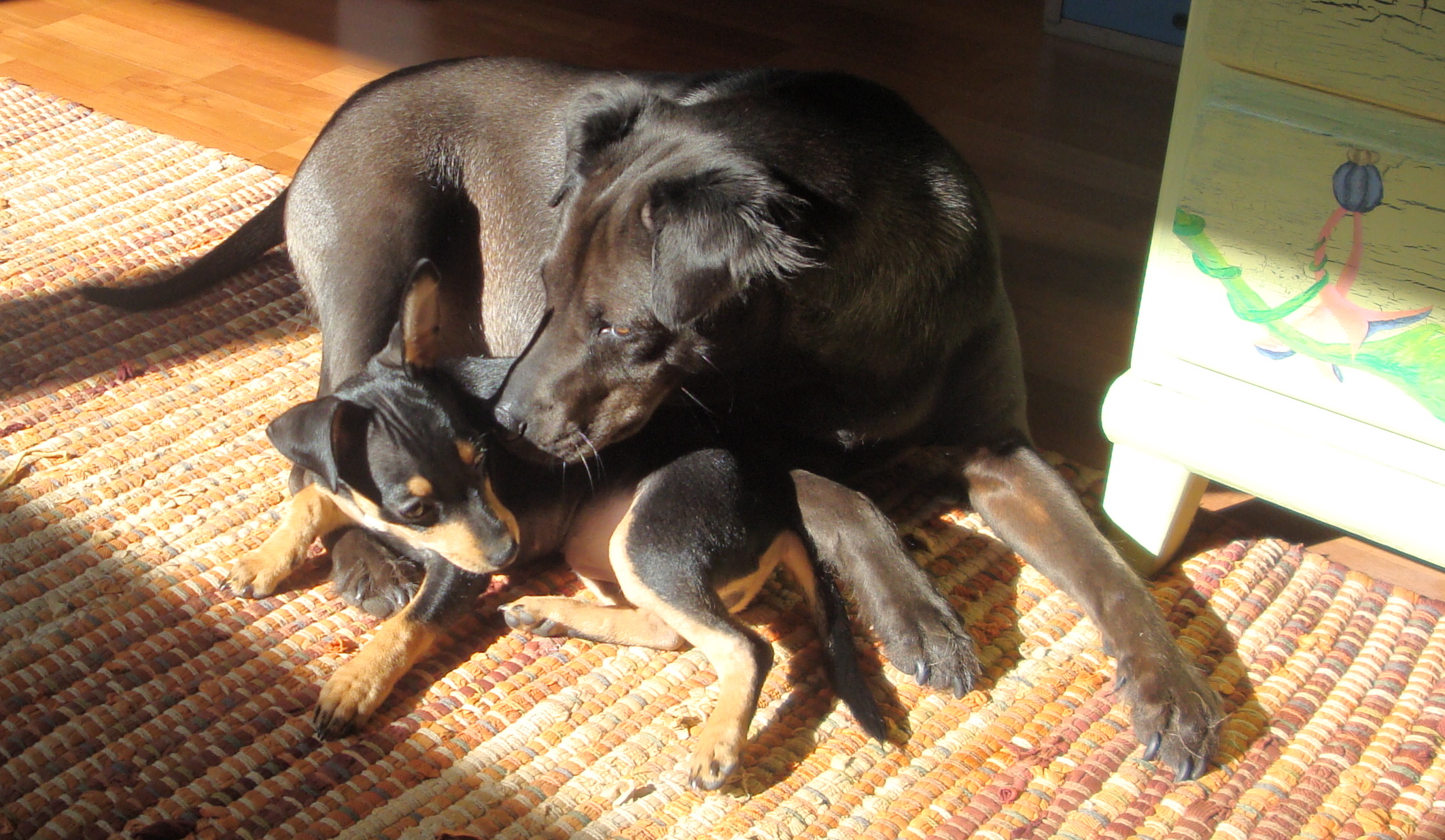

Note: In the advent of St. Patrick’s Day and my blogoversy, a few weeks of celebrating all things Irish, coming up.
-
busy, busy, busy…
But I knew you would want to see and hear about how Zoë is doing. Great! She learned how to come down the steps yesterday, and she was very proud of herself.

More news update: As a birthday gift to myself, I ordered my ticket to Bali for July 12th, somehow the credit card transaction was hacked into, unauthorized charges were made, credit card was cancelled, plane ticket order was cancelled. Tomorrow is another day!


My cousin’s guesthouse. Let me know if you are interested in renting it (any time other than next July – it’s mine then!). Very reasonable, maid service included.
I am meeting with the banker on Wednesday to sign paperwork for the property on Lily River. Closing is scheduled for the 27th. Then cabin planning starts in earnest. I have quite a few volunteers already lined up! What are you doing next May??


About Me
The sky is not completely dark at night. Were the sky absolutely dark, one would not be able to see the silhouette of an object against the sky.
Follow Me On
Subscribe To My Newsletter
Subscribe for new travel stories and exclusive content.
 ...Kopi Time